When it comes to “dimensions”, many first think of anime culture. However, in the field of automated equipment for punch press peripherals, it refers to the technical dimensions and operational degrees of freedom of manipulators—factors that directly determine the equipment’s application scenarios and production capacity. Operating within the 2D (planar) dimension, when repetitive planar stamping tasks meet the demand for automated upgrades, the 2D stamping manipulator, a master of planar operations, consistently delivers optimal solutions through its proven capabilities.
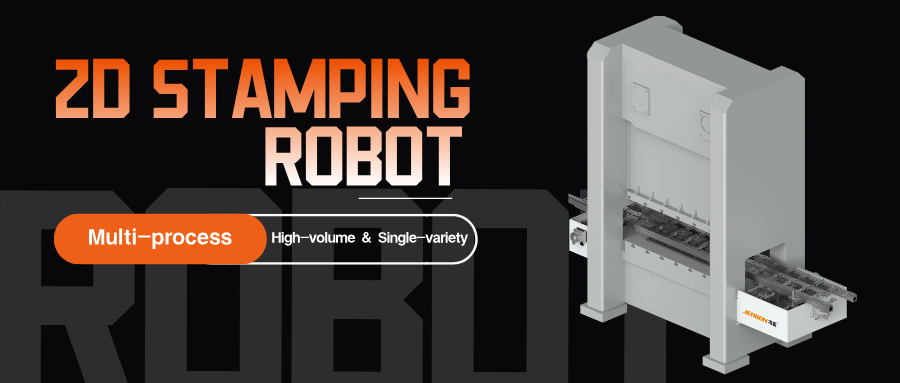
Two Dimensions, Holding the Code to Efficiency
Specializing in planar movements along the X and Y axes, the 2D manipulator’s core competitiveness lies in mastering simple tasks to perfection. Without redundant motion mechanisms, it has honed the essential skills of precise grabbing and stable transferring: in planar operation scenarios, it boasts faster response speeds, smoother action transitions, and each extension/contraction aligns precisely with production rhythms. For enterprises manufacturing small workpieces, this “specialized and refined” design directly addresses pain points—no complex multi-axis control is required to achieve efficient grabbing and transferring of metal parts. Simply put, it does not pursue versatility, but it is undoubtedly an efficiency leader with expertise in its domain.
Three Core Advantages, No Shortcomings in Adaptability
Easy Operation & Quick Mastery: Streamlined control logic lowers the operational threshold—workers can grasp usage quickly after simple training. Equipment commissioning cycles are short, and production launch speed exceeds expectations.
Reliable Repeat Positioning Accuracy: Stable repeat positioning accuracy within the plane ensures consistency for both mass-produced small metal components and precision electronic parts, reducing defect rates.
Outstanding Cost-Efficiency: Tailored for multi-process, high-volume production needs, it achieves a production efficiency of 30-45 cycles per minute, significantly boosting output.
Facing increasingly refined professional division of labor, the 2D stamping manipulator demonstrates remarkable advantages: its solid basic functions effectively drive productivity innovation. It optimizes the operational model of stamping automation, enhances focus and efficiency, while lowering implementation barriers—laying a solid technical foundation for enterprises’ stamping automation and intelligent upgrading.